
IMPACT
12
new customers joined Factorial even before launching the feature
+50K €
of ARR

The customer problem
Disconnected tools: Objectives sit in one tool and payouts in another, with nothing connecting what someone achieved to what they're owed.
Manual work: Someone in People or Finance translates each person's achievement percentage into a payout by hand, applying weights and rules that only exist in a document.
Transparency: When a payout looks off, there's no trail to follow, and the employee can't answer a simple question: "why did I get paid this?"
"Two of us, two weeks, every single quarter. Half of it is just chasing managers to update their objectives, and then answering every employee who asks why their pay is what it is."
- Laura, HR Manager at Lefebvre
The business problem
The opportunity had been known for years, but every previous attempt had collapsed under its own complexity. Configuring incentive plans meant dealing with countless rules, exceptions and edge cases, making it difficult to build a solution that was both flexible and easy to use.
The cost of leaving the problem unsolved was clear:
Goals feature struggled to retain customers year over year.
HubSpot data linked the pain point to +50K € in ARR that this feature could unlock.
AI was in the loop from research to prototyping, but human judgment stayed at the heart of every decision.
1. Discovery
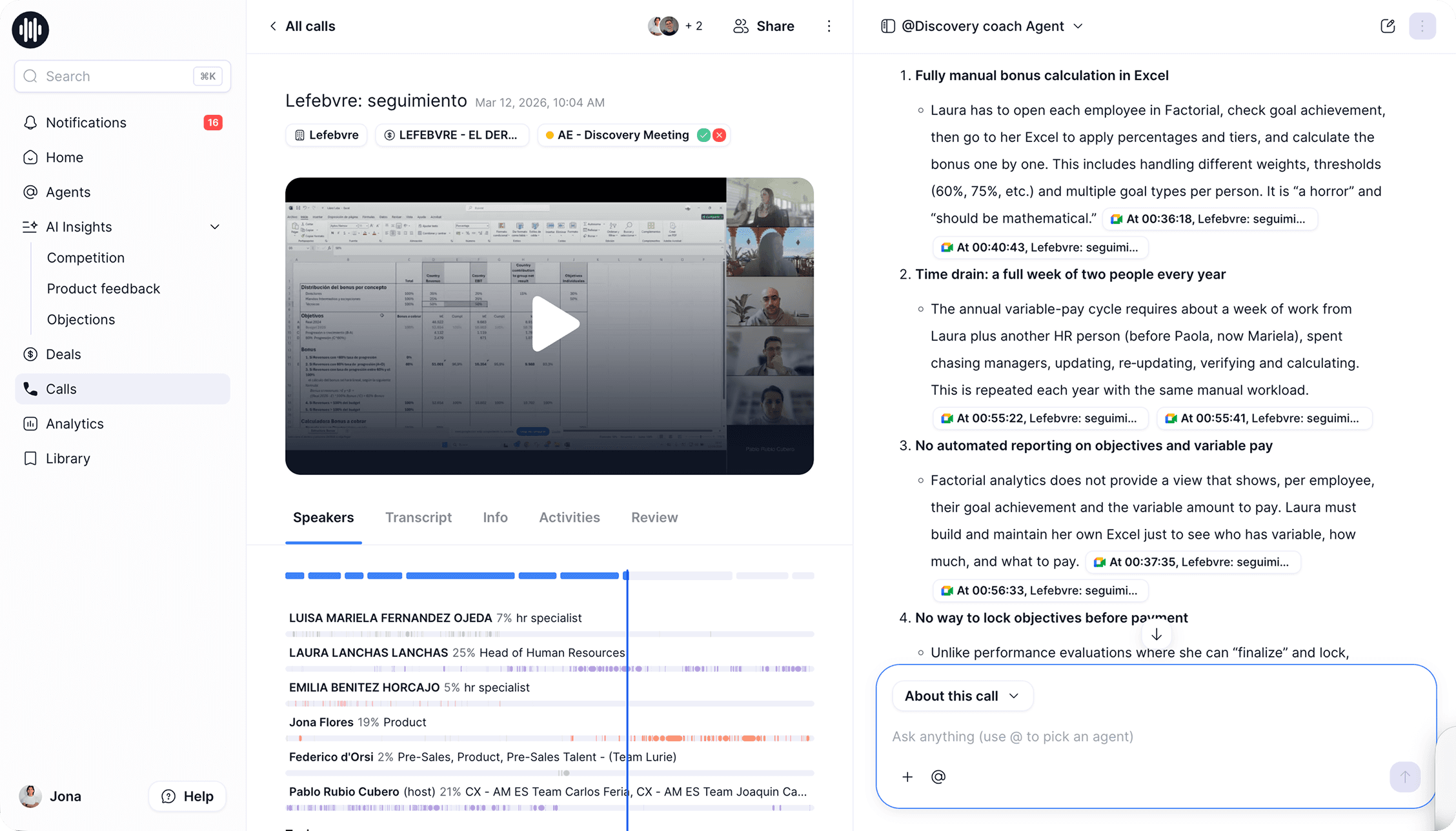
I initially thought the hardest part would be calculating payouts. The interviews revealed the opposite: companies already knew how to calculate them. They struggled to configure plans consistently and explain the results.
I interviewed HR, Finance and Payroll teams, alongside Factorial stakeholders to understand their processes and needs. AI accelerated the synthesis. Modjo helped identify recurring pain points and domain terminology, while Gemini's Deep Research supported the competitive analysis.
AI reduced days of work to hours, but the analysis, prioritization and product decisions remained human.
The key Jobs to be done
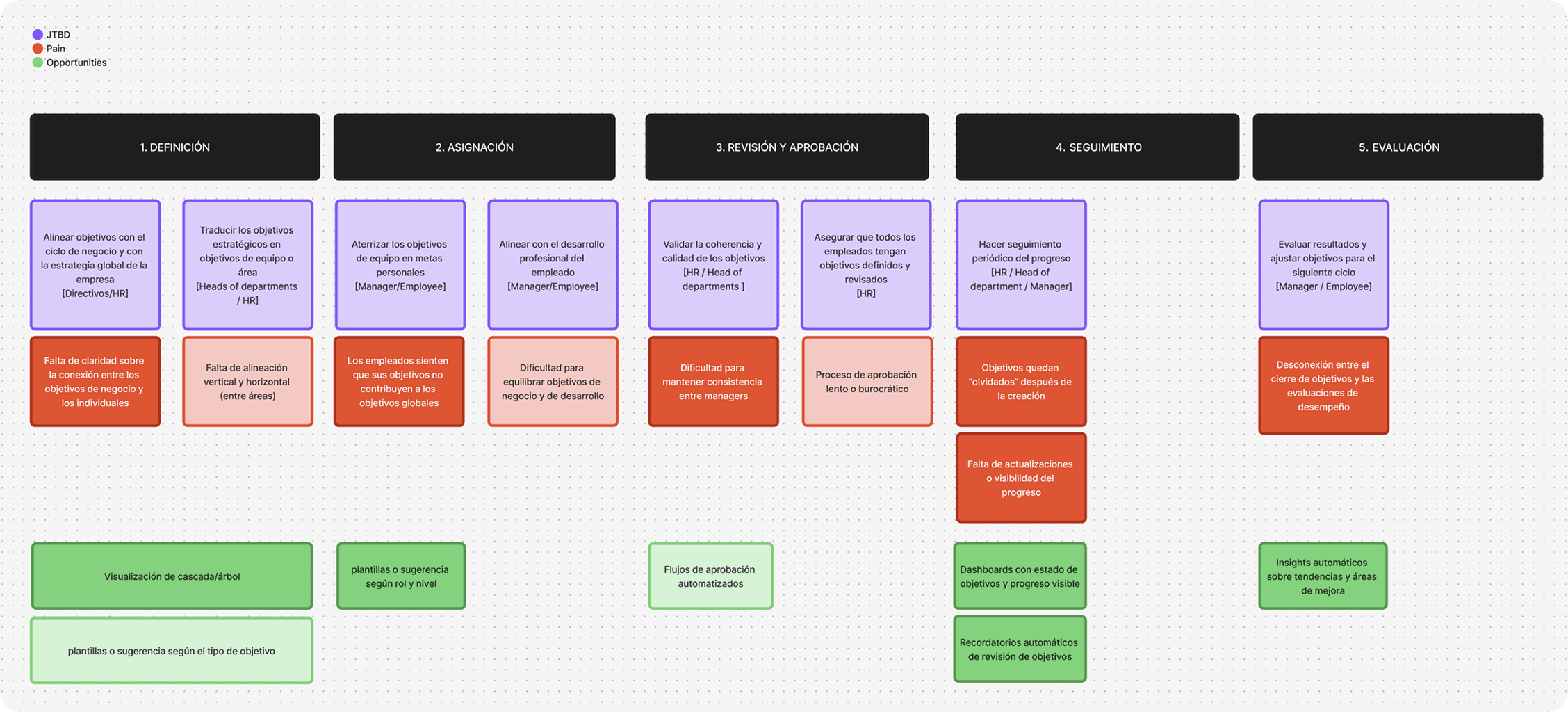
Although the research surfaced many different needs, I distilled them into three core jobs that guided the entire product.
Reward performance, without spreadsheets
HR & Finance: Set goals, weights and payout rules in one place, and reward performance with a clear and consistent system.
Pay accurately, on time
Finance: Automatically calculate payouts based on actual performance and send the right numbers to payroll.
Understand how I earned my payout
Managers & ICs: See which goals drove the payout and how the calculation was made, so the outcome feels fair and transparent.
2. Ideation
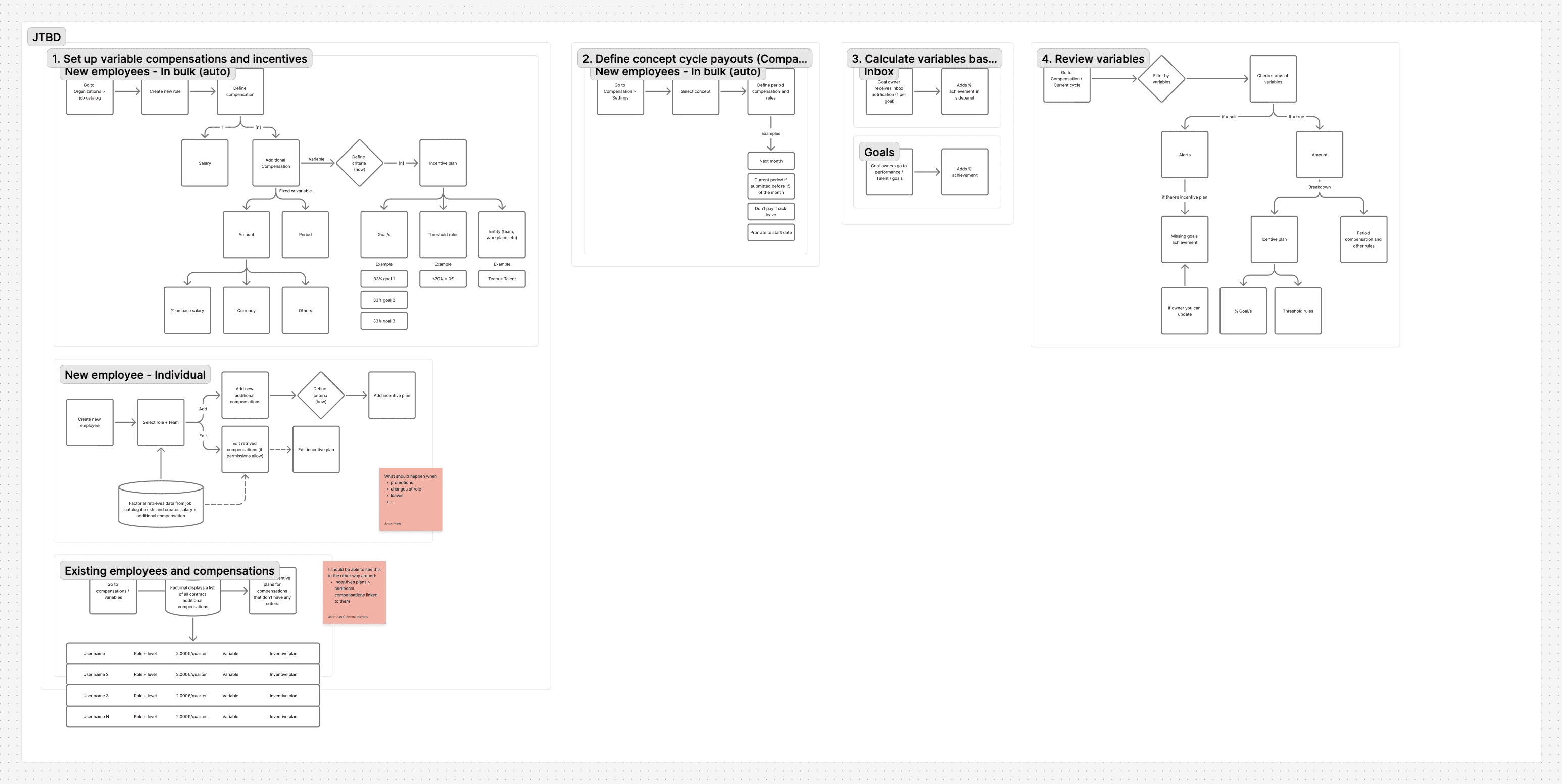
Mapping the end-to-end experience
Before designing the feature itself, I needed to understand how Incentive Plans would fit into the broader ecosystem.
We ran cross-functional workshops to map the journey across Performance, Compensation and Payroll, defining where variable pay should live, how it should flow into employee contracts, when managers should update objectives, and how approvals and payouts would work across modules.
Simplifying the complexity
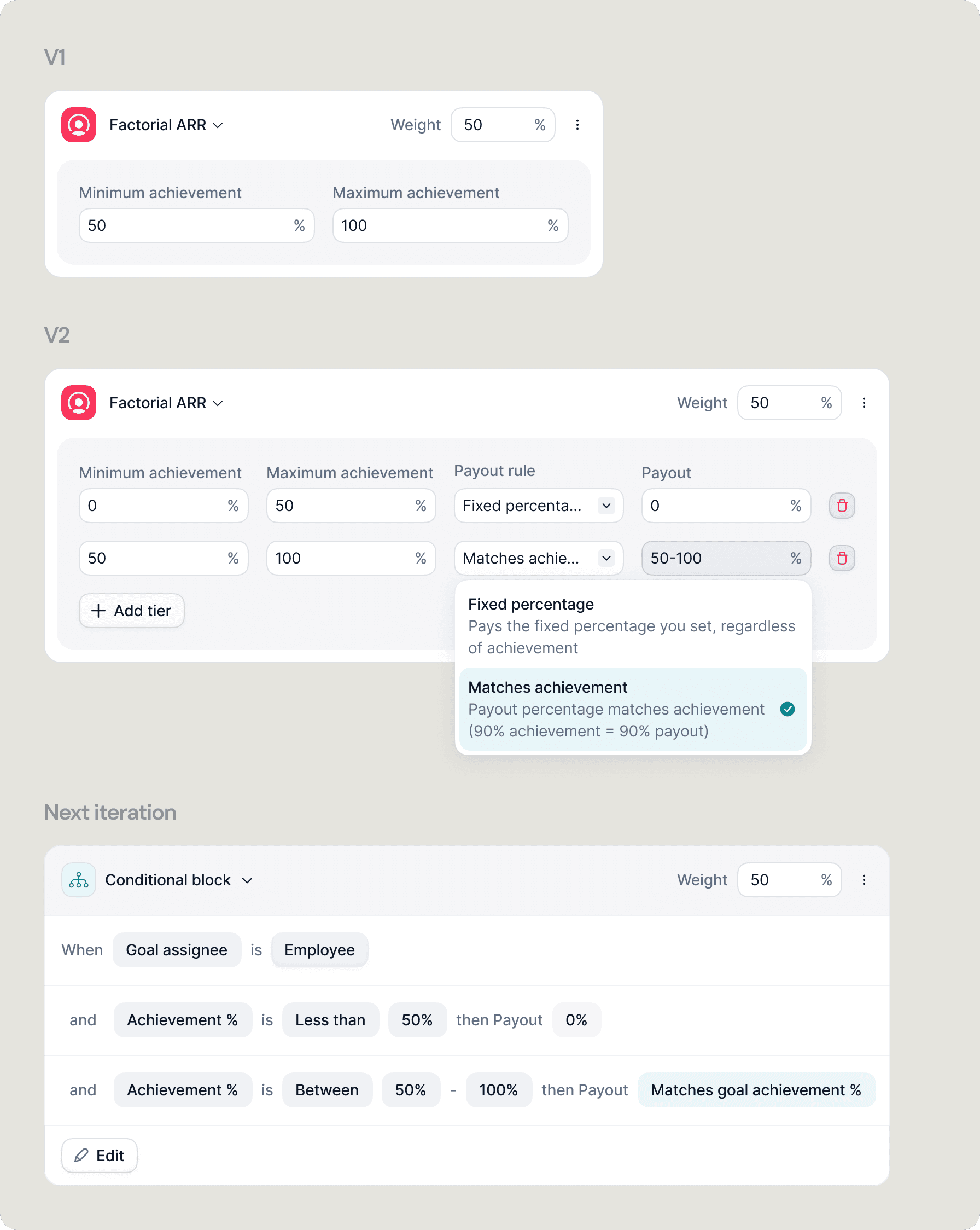
One of the hardest product decisions was deliberately not solving every use case. Initially, we tried to support multiple payout models from day one. Every new rule made the experience harder to configure, so we deliberately reduced the MVP to a single model that covered the majority of customers: a simple floor (threshold) and a ceiling (cap) on payouts.
To keep the scope focused, we excluded Sales teams and other complex compensation models, concentrating instead on non-go-to-market teams. We validated this first version internally and with three design partners before expanding further.
3. Specs & Definition
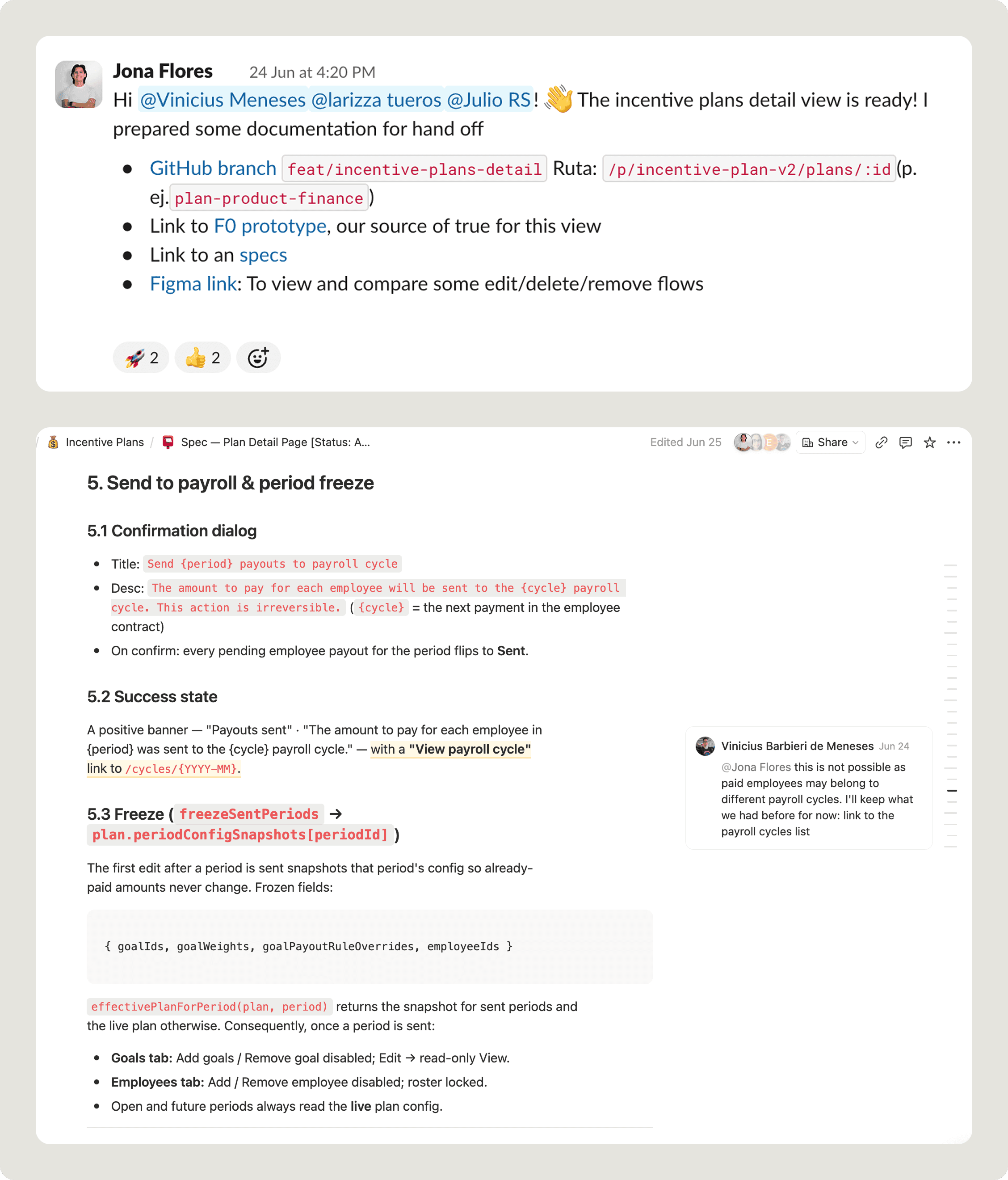
Owning the specification meant turning weeks of research, workshops and early concepts into a clear implementation plan.
Rather than documenting decisions after they had been made, writing the spec became another design exercise. Using Claude, I transformed recordings from discovery sessions, workshops and customer interviews into a structured first draft that exposed gaps, challenged assumptions and clarified edge cases before development began.
AI accelerated the process, but the product decisions remained human.
4. Vibe Coding Prototypes
I deliberately chose interactive prototypes over static mockups because this product wasn't difficult to understand visually, it was difficult to understand behaviorally.
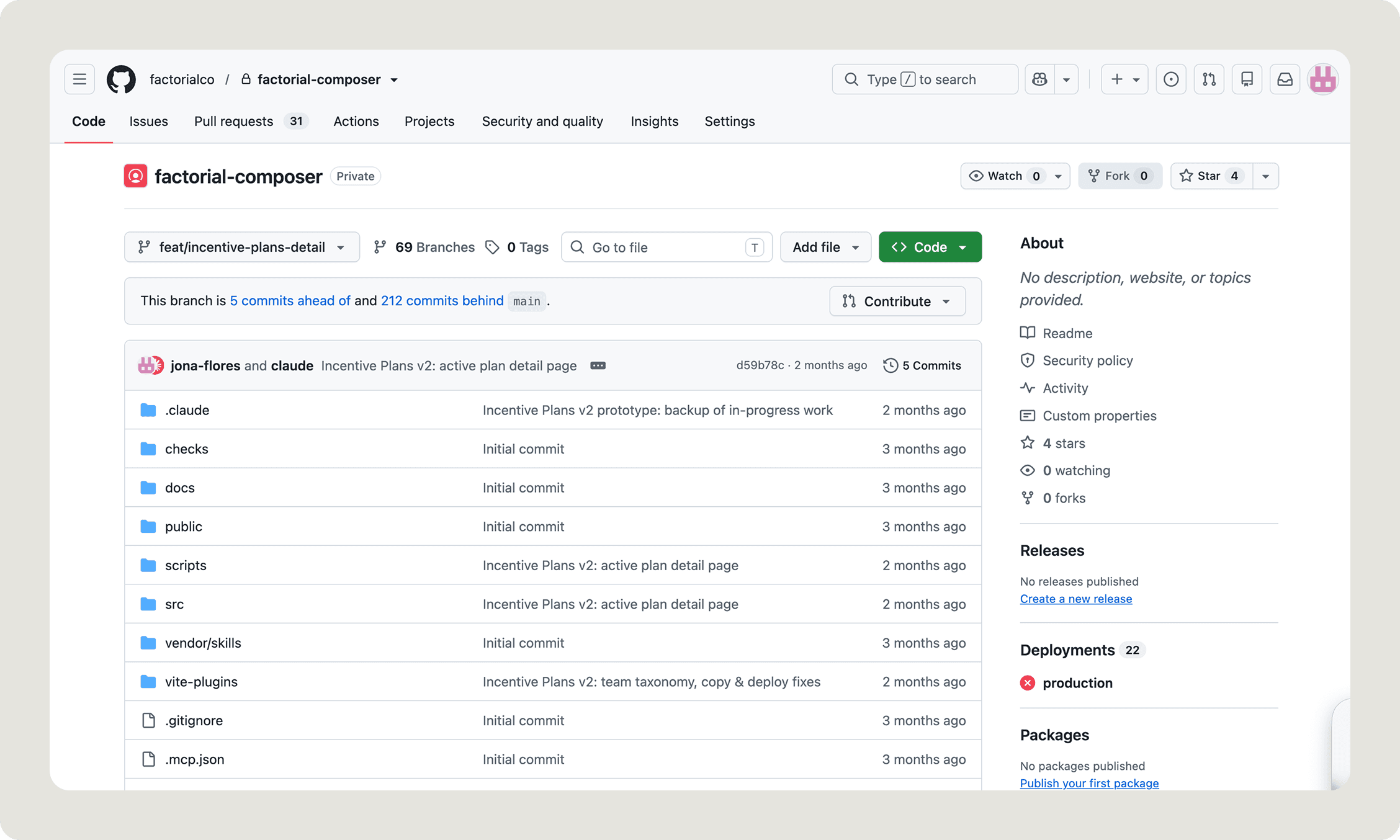
Building prototypes in code allowed stakeholders and engineers to experience the entire flow, including the payout logic, instead of interpreting static screens.
The first iterations were built with Lovable and Figma Make. Midway through the project, Factorial launched f0compose, an internal AI tool that generates production-like prototypes using our F0 design system. From then on, every prototype looked and behaved much closer to the final product. The result was faster validation, better alignment with engineering and reusable implementation code.
We approached the problem from three angles: making incentive plans easy to configure, making payouts transparent to employees, and helping customers adopt the required modules along the way.
The solution
AI-powered plan creation
Our first instinct was to expose the configuration through a traditional form. While it covered every scenario, it also surfaced the full complexity of the product upfront. We quickly realized that most users struggle with entering data, that insight led us to replace forms with a conversational flow.
Instead of navigating complex forms, managers create Incentive Plans through a conversation with ONE, Factorial's AI assistant. ONE extracts the available information, asks only for what's missing and adapts the conversation based on how much context the user provides.
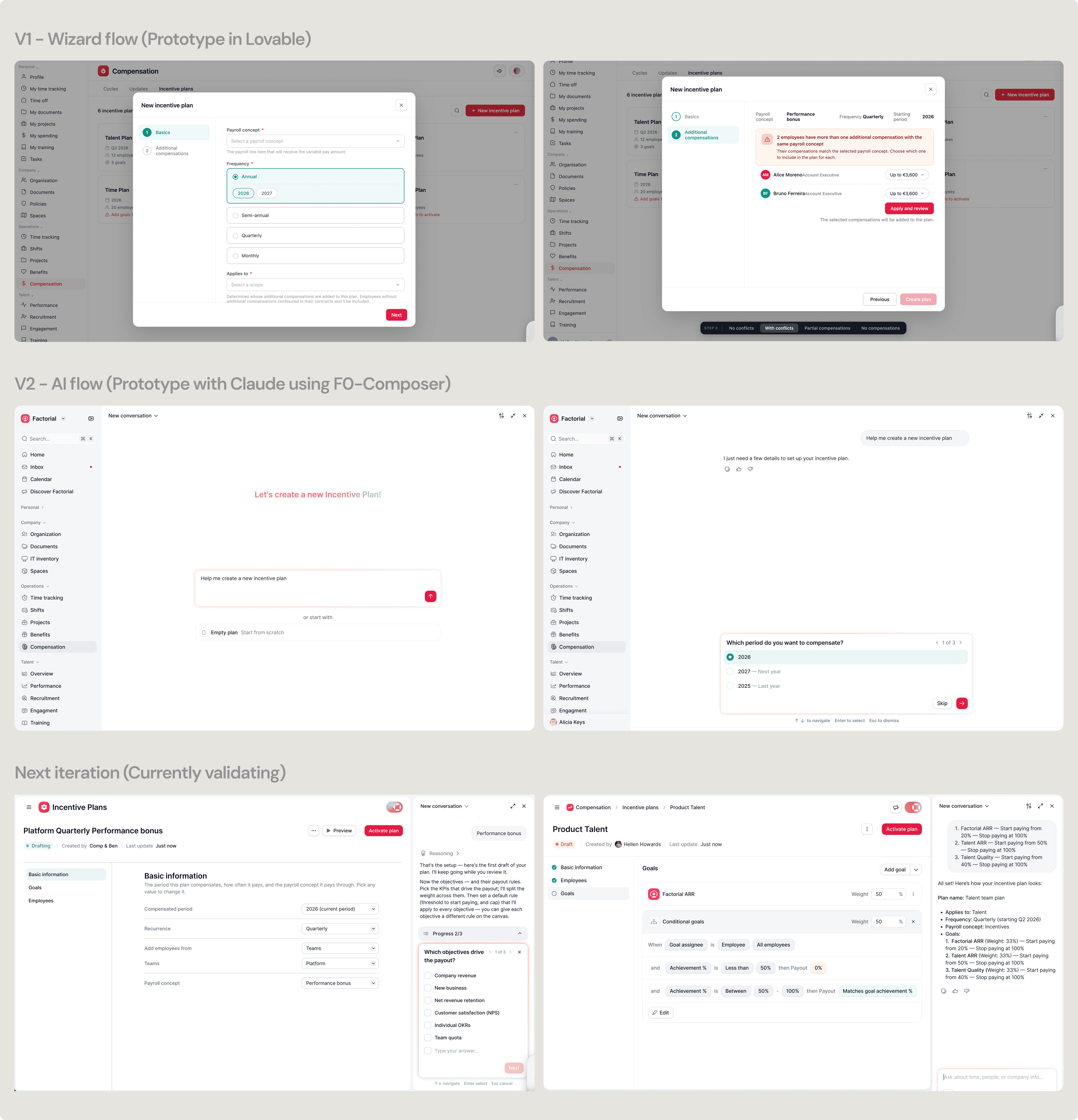
[Link to Claude prototype ↗] - Still WIP
Plan details
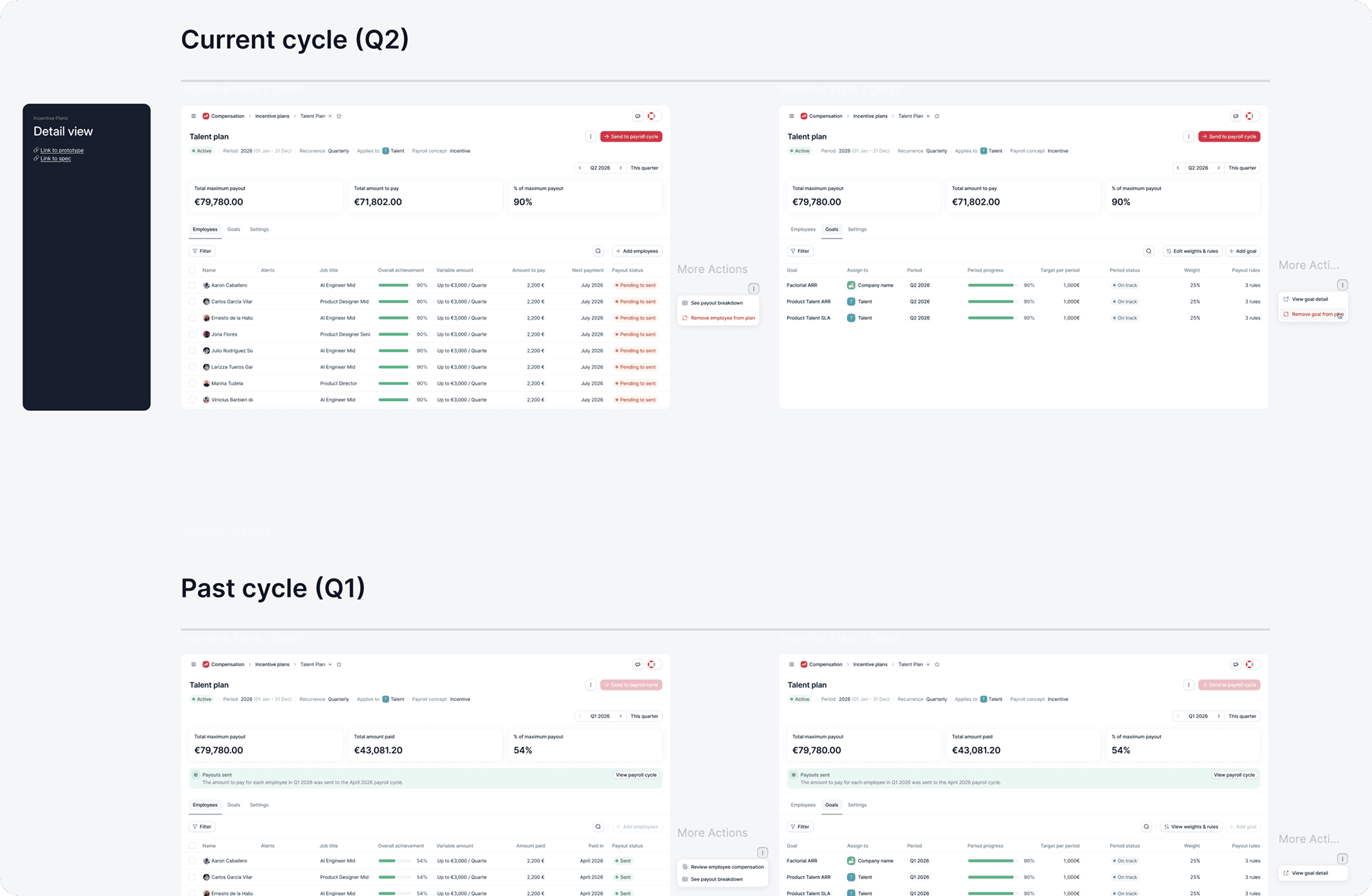
Once a plan is created, managers can track performance and payouts through a dedicated detail page. The experience explains not only what employees will earn, but also why, making variable compensation transparent and easier to trust.
Figma became a documentation layer rather than the source of truth. Variants were documented there, while the prototypes, their generated code, and the product spec became the source of truth.
Upselling points
Because Incentive Plans connects Performance and Compensation, customers need both modules to use it. Instead of presenting a single upgrade wall, I designed contextual upgrade opportunities throughout the platform, helping customers unlock the missing module exactly when they needed it.
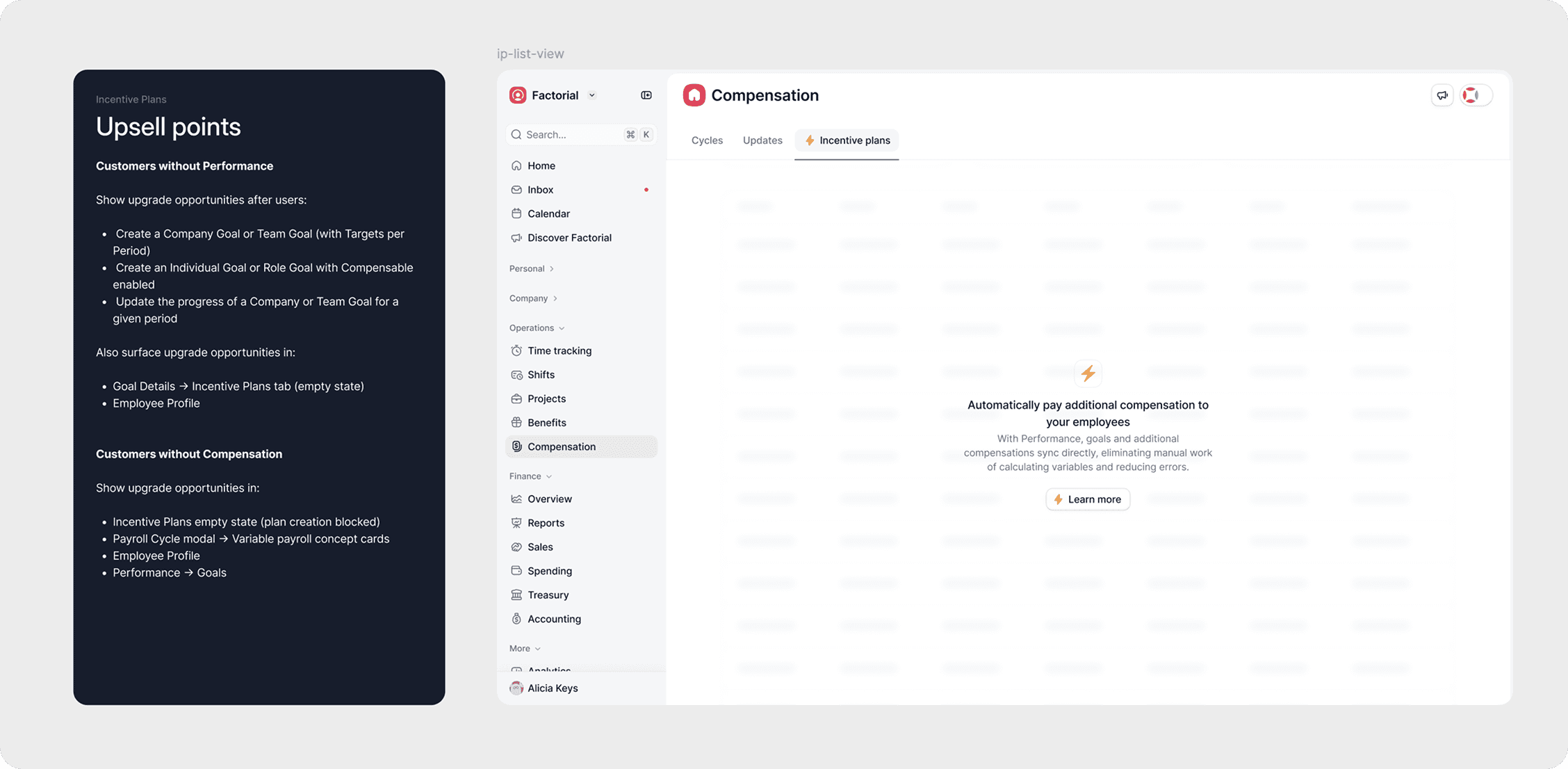
We're currently redesigning upgrade banners to make them feel more contextual and naturally integrated into the product experience.
User Testing
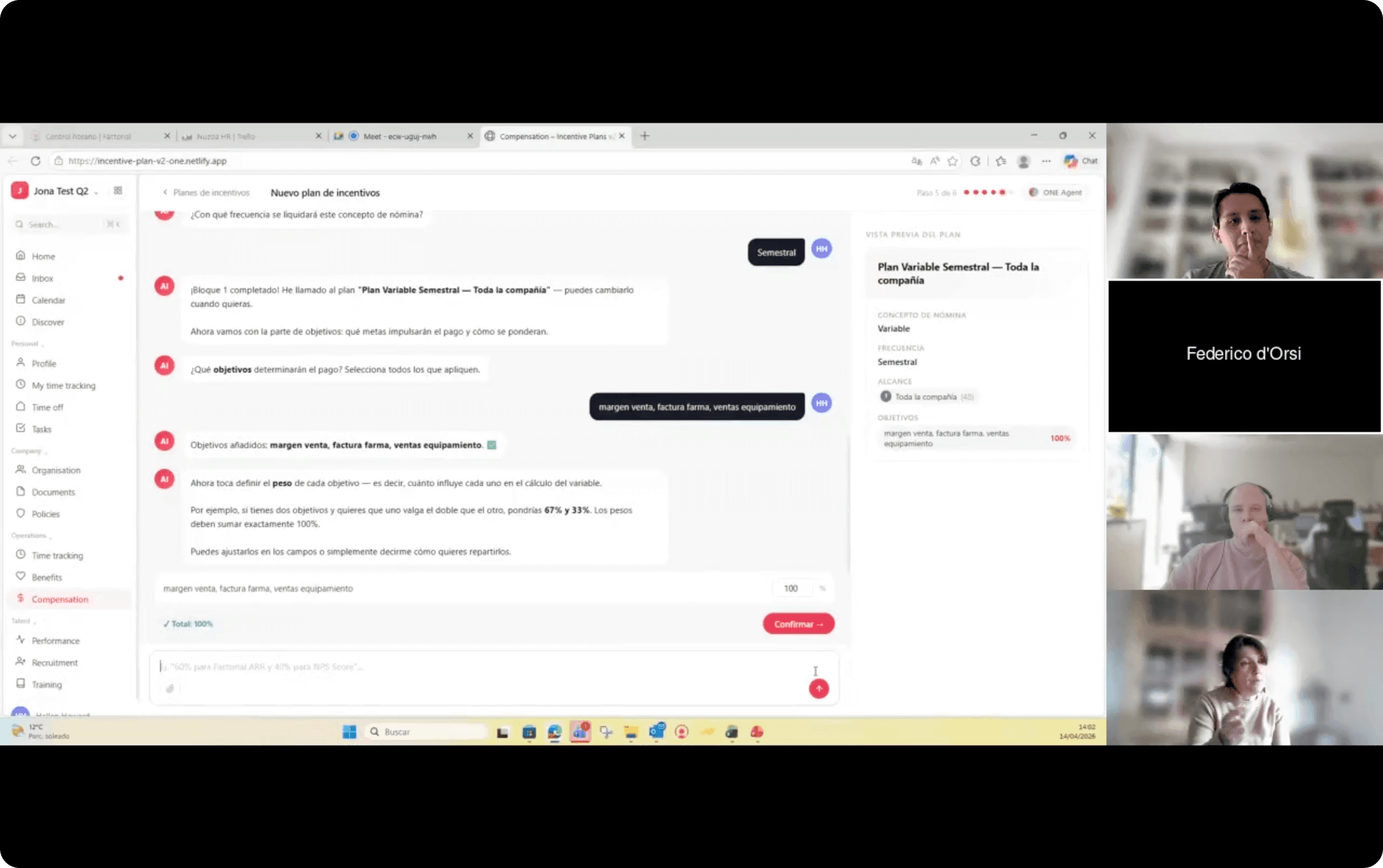
We tested the feature with design partners, prospects and Factorial's own Product team, who became our first users as we replaced our existing variable compensation tool.
I wasn't looking only for usability feedback. I wanted to understand whether managers trusted AI-generated plans and whether employees could understand their payouts without additional explanation. The sessions led to several UX improvements before implementation, while dogfooding the product internally gave us continuous, real-world feedback and increased confidence before the public rollout.
Learnings & Insights
Focus on what matters
One of my biggest learnings from this project was the importance of prioritization. There had been ambitious visions for this product that could have brought real value to customers, but with limited time and resources, I learned that solving the most important problems first creates far more impact than trying to solve everything at once.
Validate continuously
Building close relationships with customers made continuous validation possible. Shipping the feature internally before launching took that further: we turned Factorial into our first customer and got first-hand feedback from day one. Frequent validation helped us uncover usability issues early, iterate faster, and build with greater confidence.
Good and fast beats perfect and slow
This project changed the way I work. AI dramatically reduced the time spent on research synthesis, writing specifications and prototyping, allowing me to reach a testable product much faster. But while AI accelerated execution, the product thinking, prioritization and design decisions remained entirely human.